The Bahia Palace is one of Marrakech’s most beautiful monuments, a 19th-century residence of courtyards, gardens and richly decorated rooms that shows Moroccan craftsmanship at its finest. Its name means “brilliance”, and it lives up to it. This guide explains the palace’s history, what to look for inside, and how to make the most of your visit.
A Short History of the Bahia Palace
The palace was built in the second half of the 19th century. Construction began under Si Moussa, grand vizier to the sultan, and was greatly expanded by his son Ba Ahmed ben Moussa, who served as grand vizier and became one of the most powerful men in Morocco at the turn of the 20th century.
Ba Ahmed wanted a residence that reflected his status, and he brought in craftsmen from across the country, including Fes, to decorate it. The result was a sprawling complex of rooms, courtyards and gardens. After his death in 1900 the palace was emptied of much of its furniture and treasures. During the French protectorate it was used as a residence by the French authorities. Today it belongs to the Moroccan state and is open to visitors, while parts are still used for official purposes.
What to See Inside
The courtyards
The palace is designed around a series of courtyards and riads (interior gardens). The largest, the Grand Courtyard, is paved in marble and surrounded by galleries with carved wooden columns, a striking open space after the narrow lanes of the medina.
Zellij tilework and carved stucco
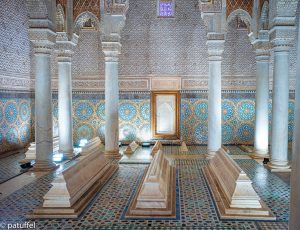
Look closely at the walls: intricate zellij mosaics run along the lower walls, while carved stucco rises above them in geometric and floral patterns. Much of this decoration was done entirely by hand.
Painted cedar ceilings
The ceilings are a highlight. Many are made of carved and painted cedar wood, with colours and patterns that differ from room to room. Take your time and look up as you move through the palace.
Gardens and fountains
Orange trees, palms and fountains bring shade and calm. The gardens show how wealthy Marrakech families created private, inward-looking spaces sheltered from the heat and noise of the city.
The private apartments
Smaller rooms around secondary courtyards were the living quarters of the vizier’s household. They give a sense of how the palace was organised and how domestic life was separated from public reception areas.
Tips for Visiting the Bahia Palace
- Go early. The palace is one of the city’s most popular sites; mornings are calmer and the light in the courtyards is softer.
- Check opening hours and ticket prices before you go, as they can change, and the palace sometimes closes for official events.
- Allow about an hour to see it properly without rushing.
- Visit with a guide to understand the symbolism of the decoration and the story of the family who built it. Many details are easy to miss on your own.
- Wear comfortable shoes and bring water in warm months.
How to Combine the Bahia Palace with Nearby Sights
The palace lies on the southern side of the medina, close to the Mellah (the historic Jewish quarter), the Saadian Tombs and the remains of the El Badi Palace. These sites can easily be visited together in a half day, ending with a walk through the souks and Jemaa el-Fna in the late afternoon.
Read our guide to the Saadian Tombs and the Koutoubia Mosque to plan your route.
Frequently Asked Questions
How long do you need at the Bahia Palace?
Most visitors spend 45 minutes to an hour. If you enjoy architecture and photography, allow a little longer.
Is the Bahia Palace worth visiting?
Yes. It is one of the best places in Marrakech to see traditional Moroccan decorative arts in a single, well-preserved setting.
Can you visit the Bahia Palace on a tour?
Yes. It is a standard stop on guided city tours, which also include the medina, the souks and other monuments.
Discover the Bahia Palace with a Private Guide
Our private Marrakech city tour includes the Bahia Palace and the medina’s main highlights, with a licensed local guide who brings the history to life. Contact us to arrange your visit.