Hidden behind high walls for centuries, the Saadian Tombs are one of Marrakech’s most atmospheric historic sites. The mausoleums hold members of the Saadian dynasty, which ruled Morocco in the 16th and early 17th centuries, and their decoration is among the finest in the country. This guide covers their history, what to see and how to plan your visit.
The Saadian Dynasty and the Tombs
The Saadians rose to power in the 16th century and made Marrakech their capital. Their most famous ruler, Sultan Ahmad al-Mansur, reigned from 1578 to 1603. His victory at the Battle of the Three Kings in 1578 and the wealth that followed financed an era of grand building in the city.
The tombs were developed as a royal necropolis next to the Kasbah Mosque. Al-Mansur had the most lavish mausoleum built for himself and his family. After the dynasty fell, the later Alaouite sultan Moulay Ismail is said to have sealed off the site rather than destroy it. The tombs remained largely forgotten until the early 20th century, when they were rediscovered in 1917 during the French protectorate, restored and opened to the public.
What to See at the Saadian Tombs
The Hall of Twelve Columns
The most celebrated chamber is the Hall of Twelve Columns, which contains the tomb of Ahmad al-Mansur. Slender columns of Carrara marble support a ceiling of intricately carved and gilded cedar, while carved stucco and zellij tiles cover the walls. Visitors view this room from the doorway, so expect a short queue at busy times.
The Prayer Hall
Next to it, the prayer hall with its mihrab is decorated with delicate stucco work. Several tombs, including those of family members, lie in this space.
The second mausoleum
The second, older mausoleum holds the tombs of Mohammed ash-Sheikh, founder of Saadian rule in Morocco, and of Lalla Mas’uda, the mother of Ahmad al-Mansur. It is more modest but still beautifully decorated.
The garden graves
Around the mausoleums, a small garden contains the graves of soldiers, servants and other members of the court, marked with colourful tiles.
Tips for Visiting
- Arrive early to avoid the longest queues at the Hall of Twelve Columns.
- Check current opening hours and entry fees before your visit, as they can change.
- Allow 30 to 45 minutes. The site is compact but rewards a slow look at the details.
- Respect the setting: this is a burial place, so keep voices low and dress modestly.
- Go with a guide to understand the history of the Saadians and the meaning behind the decoration.
Combining the Saadian Tombs with Other Sights
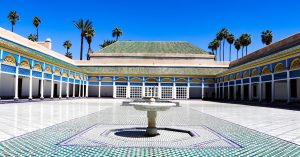
The tombs are in the Kasbah district, near the Bab Agnaou gate. They pair naturally with the El Badi Palace, al-Mansur’s ruined palace, and the Bahia Palace, all within walking distance. A morning spent on these sites, followed by lunch and an afternoon in the souks, makes an excellent first day in Marrakech.
Frequently Asked Questions
Why were the Saadian Tombs hidden?
According to tradition, Moulay Ismail sealed the tombs to diminish the memory of the previous dynasty without destroying a sacred burial place. They were rediscovered in 1917.
Are the Saadian Tombs worth it?
Yes. Although the site is small, the craftsmanship in the Hall of Twelve Columns is some of the finest in Morocco.
How do I get there?
The tombs are a short walk from Jemaa el-Fna through the Kasbah area. Many visitors include them in a guided walking tour of the medina.
Visit the Saadian Tombs on a Private Tour
Discover the Saadian Tombs, the Bahia Palace and the medina with a licensed local guide on our private Marrakech city tour. Get in touch to plan your day.